Kunstpassagens udstillingsrum – 6.11.26-20.12.26
Platformens website
Adresse: Kunstpassagen ved RØST i Sydhavnskvarteret, Kalkværksvej 27, 8000 Aarhus C
Åbningstider: Alle dage, døgnet rundt
I værket Atelier i 2d ser vi et rum lavet af genbrugstekstiler. Rummet forestiller Cecilie Julie Holst Christensens forhenværende atelier på Det Jyske Kunstakademis tidligere adresse i Mejlgade. I det sidste år på akademiet hang gardinet foran atelieret og kunne trækkes til og fra for fordybelse. Værket afspejler en kurateret version af det, der gemte sig bag stoffet. Kun udvalgte elementer er syet ind i rummet, og hvert element gør sit for at skildre sin virkelig pendant: Arbejdspladsen ved skrivebordet, det grønne gulv, nogle udvalgte værker fra Cecilies tid på akademiet, og udsigten over toppen af skolens gård. En udsigt som nu er flyttet med gardinet.
I flytningen af værket, bliver det til en form for dokumentation; en dokumentation af tidligere værker, af et sted og af en tid. Den tid, der ligger i sy-arbejdet, og i Cecilies tid på akademiet. Derudover opstår der en forskydning i gardinets funktion. Det er ikke blot fraflyttet det rum, der afbilledes, det er også flyttet ind bag glas. Gardinets oprindelige funktion er umuliggjort, og åbner op for spørgsmålet om, hvad det nu dækker af for?
Hvor værket før hang foran atelieret, og efterlignede en opryddet version af sig selv, fremstår det nu som en lille portal. Og som et glimt i øjenkrogen af Matilde Duus og Schmidt, Hammer, Lassen Architects’ udsmykning kan man stå foran gardinet og forestille sig det sted, der før lå bag, og hvad det nu gemmer på.
Cecilies værk forbinder den nye bydel på Sydhavnen, hvor Det Jyske Kunstakademi er flyttet til, med akademiets tidligere, historiske bygninger og fortid i Mejlgade. Som en lille portal mellem fortiden og fremtiden, markerer værket en forbindelse mellem et tidligere og et fremtidigt kunstmiljø, imellem en ældre byhistorie og nye koblinger mellem industri, produktion og information. Samtidig får vi et lille indblik i kunstnerens atelier, i grænsefladen mellem fordybelse, produktion og udstilling.
Cecilie Julie Holst Christensen arbejder på tværs af en række forskellige medier, med en særlig interesse for tekstiler, tekst og performance. Hun er interesseret i øjeblikke, hvor man oplever et brud med "virkeligheden", hvor det akavede, forvirrende eller absurde afslører hverdagens performativitet. Cecilie Julie Holst Christensen (f. 1997) er uddannet fra Det Jyske Kunstakademi i 2025.
Kunstneren er inviteret af Matilde Duus og udstillingen er organiseret af Det Jyske Kunstakademi og Aarhus Billedkunstcenter. Udstillingen er støttet af A. Enggaard´s Bylivsforening i Sydhavnen.
https://ceciliejhchristensen.com/
https://www.instagram.com/cillemouse_original/
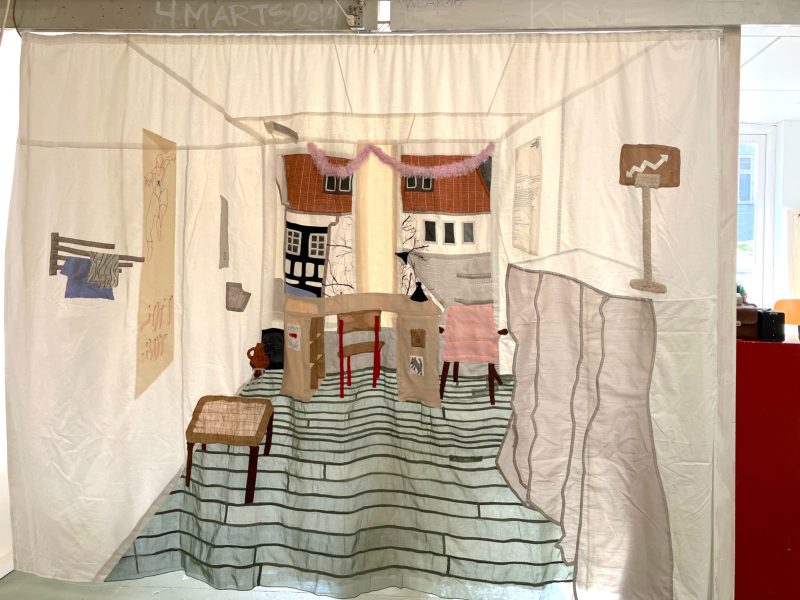
Foto: Cecilie Julie Holst Christensen, ’Atelier i 2d’, 2025 (foto: Cecilie Julie Holst Christensen)
TEXT IN ENGLISH
Cecilie Julie Holst Christensen, ‘Atelier in 2d’, 2025
6.11.26–20.12.26
In the work Atelier in 2d, we see a room made of recycled textiles. The room depicts Cecilie Julie Holst Christensen’s former studio at the Jutland Art Academy’s previous address on Mejlgade in central Aarhus. In her last year at the academy, a curtain hung in front of Cecilie’s studio that could be drawn open and closed for concentration.
The work reflects a curated version of what was hidden behind the curtain. Selected elements are sewn into the room, each portraying its real-life counterpart: the desk workspace, the green floor, selected works from Cecilie’s time at the academy, and the view over the top of the school’s former courtyard. A view that has now moved along with the curtain.
In the relocation of the work, it becomes a form of documentation: documentation of earlier works, of a place, and of a time. The time spent sewing the work, and Cecilie’s time at the academy. Furthermore, a shift occurs in the curtain’s function. It has not only moved out of the room it depicts, it has also been placed behind glass. The curtain’s original function has been made impossible, which raises the question: what does it now cover?
Where the work previously hung in front of the artist’s studio, it now appears as a small portal within the surrounding public art commission by artist Matilde Duus and Schmidt Hammer Lassen Architects. Now, one can stand in front of the curtain and imagine the place that used to lie behind it, and what it now conceals.
Cecilie’s work connects the new urban district in Sydhavnen, where the Jutland Art Academy is now based, with the academy’s former, historic buildings on Mejlgade. As a small portal between the past and the future, the work marks a connection between a past and future art environment, between an older urban history and new links between industry, production and information. At the same time, we get a small glimpse into the artist’s studio and the interface between concentration, production and exhibition.
Cecilie Julie Holst Christensen works across a range of media, with a particular interest in textiles, text and performance. She is interested in moments when one experiences a break from “reality,” where the awkward, confusing or absurd reveals the performativity of everyday life. Cecilie Julie Holst Christensen (b. 1997) graduated from the Jutland Art Academy in 2025.
The artist was invited by Matilde Duus, and the exhibition is organized by the Jutland Art Academy and Aarhus Center for Visual Art. The exhibition is supported by A. Enggaard’s Bylivsforening in Sydhavnen.
Kunstpassagen’s Exhibition Space
The exhibition space is a new platform for art in public space in Sydhavnen in Aarhus, integrated into Kunstpassagen and into a public art commission created in close collaboration between visual artist Matilde Duus and Schmidt Hammer Lassen.
Kunstpassagen’s exhibition space is part of a joint program for temporary art in the northern part of Sydhavnen, which also includes Platform for Sound Art. The program brings contemporary art into play as a co-creator of a new urban neighbourhood.
After industry moved out of the northern part of Sydhavnen, the area has attracted artists and other creatives, and has also become a place of belonging for socially vulnerable citizens. In recent years, the northern part of Sydhavnen has been developed into an urban neighbourhood with business, education, and producing culture and art, including the Jutland Art Academy, Aarhus Billedkunstcenter and Annika Nuttall Gallery.